
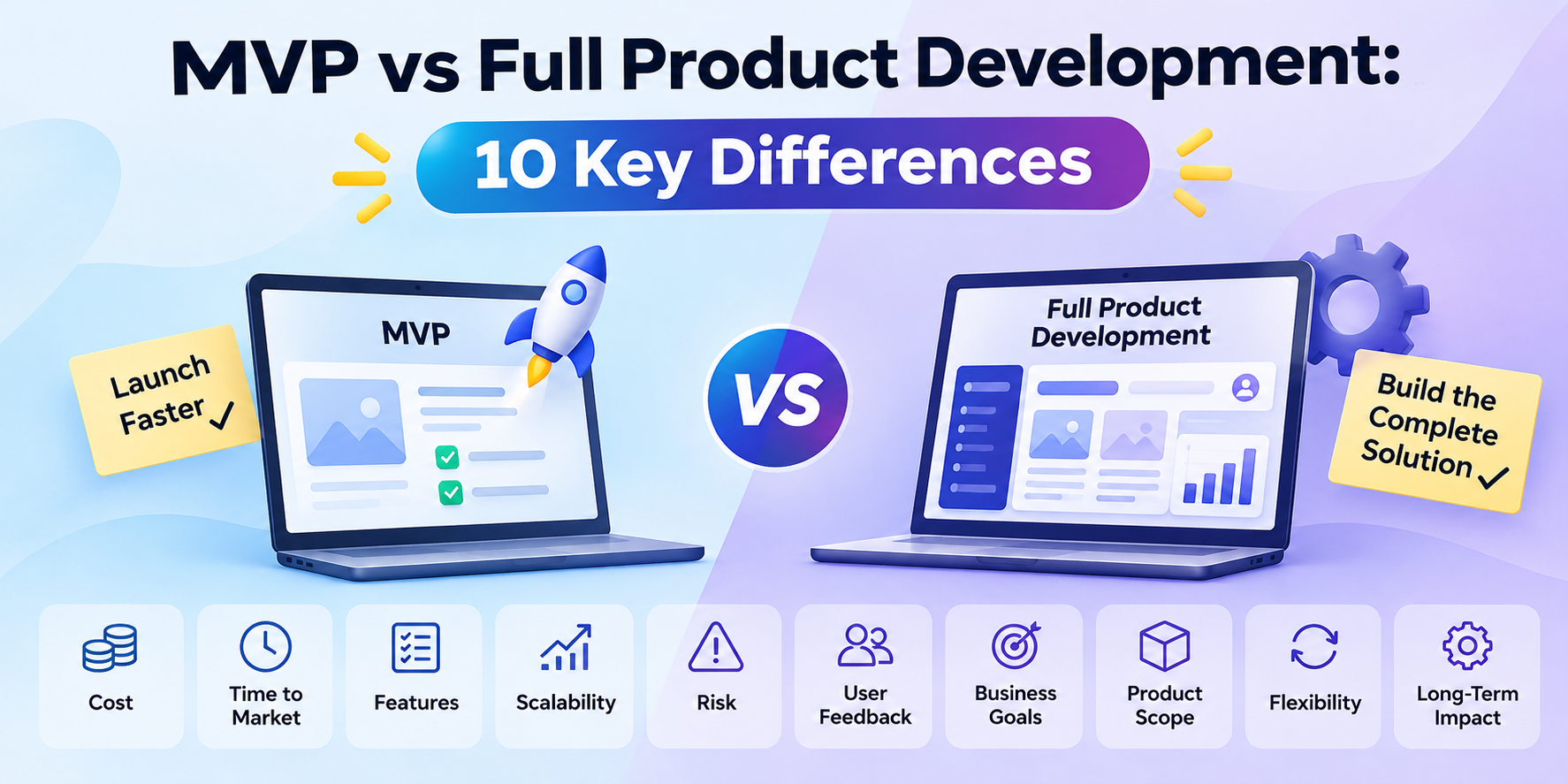
MVP vs Full Product Development: 10 Key Differences

Many first-time founders are stuck with the question: should we build the whole product or start with something smaller? An MVP, short for minimum viable product, is the simplest version of your idea that real users can try. A full product is the complete version, with every planned feature, polished design, and support in place.
Knowing the difference between MVP development and Full Product development will help you allocate your budget correctly. When starting out with a small MVP, MVP Developers for Hire can get you to market quickly.
1. Purpose
An MVP is meant to be tested to see if people want the product. It’s not meant to be the final version of the product. The full version of the product is meant to be used by customers who already want what you’re offering. It’s meant to retain those customers and attract new ones.
2. Features
The main feature of the MVP is the solution to the main problem the app is supposed to solve. For example, for a food delivery app, the MVP could be to allow users to view a list of restaurants and order from them. For the full product, there are many more features such as reviews, loyalty points, scheduled orders, etc. This is one of the biggest mistakes that startups make, adding too many features too early.
3. Time to launch
An MVP can often be ready in two to four months, and sometimes faster. A full product may take a year or longer, depending on its size. A shorter timeline means you can start learning from real users much sooner, while competitors are still planning.
4. Cost
MVP development is much cheaper than Full Product development because there is less to design, develop and test. Full Product development requires a larger budget for development, design, testing, security and support. The money saved on the MVP can be used for later marketing and improvements of the product based on feedback.
5. Risk
Building a full product before testing the idea is risky. If users do not want it, a large amount of money and time is lost. An MVP keeps that loss small. You find out early whether the idea works, and you can change direction without much damage.
6. Design
An MVP should have a simple and easy to use design. It does not need to have the perfect design on every screen. A Full Product should have a very polished, consistent design across all devices and pay attention to even the smallest details. As your user base grows, so do their expectations of the design of your product.
7. Technology
For an MVP you can use a lot of ready-made tools and services, and even some shortcuts to get to market faster. For a Full Product you need more solid technology, i.e. it has to scale for many users, work fast, be secure and even be able to be extended with new features without breaking existing ones. Some of the code of an MVP can be thrown away, that’s normal.
8. Feedback
An MVP is primarily built to receive feedback from users. This feedback is then used to further develop the product and to improve the existing features. If you skip this step, you will be guessing as to what your users want.
9. Support and maintenance
Basic support is needed for the MVP. Bugs have to be fixed and a few questions from users have to be answered. A Full Product needs a support process, documentation, updates and monitoring. As the product is being used by more and more customers, the work to maintain the product increases as well.
10. Growth plan
The MVP is the first step of your product development and aims to help you learn about your market. The Full Product includes marketing, sales, partnerships and more in order to reach more users and to expand to other markets. These steps are most useful when you already have established demand for your product.
How to Decide Between MVP and Full Product Development?
Ask yourself a few simple questions:
- Have I confirmed that people will pay for this?
- Do I have a clear list of what users need?
- Can I afford to lose the money if this does not work?
- Do I need to launch quickly to beat a competitor?
If you are unsure about the first two questions, start with an MVP. If you have confirmed there is a market for your product and you have already established a list of features for your product then a larger build may be required. Many well-known products started off as a small, simple product and then grew as more features were requested by users.
Common Mistakes With MVPs
An MVP is not a bad or unfinished product. It should solve a problem for a user and work well. Another mistake is to build an MVP and then not use the feedback from users. The whole point of an MVP is to learn from users. Some founders keep adding features to their MVP and never launch. Set a date and stick to it.
Conclusion
Whether you decide to build a MVP or a full product, remember to focus on solving one problem for one type of user in the first version. You can always add more features later on, but you cannot get back the time and money spent on features that nobody wanted.




Responses