
Agentic AI vs Traditional AI: What’s the Difference? Complete Guide 2027

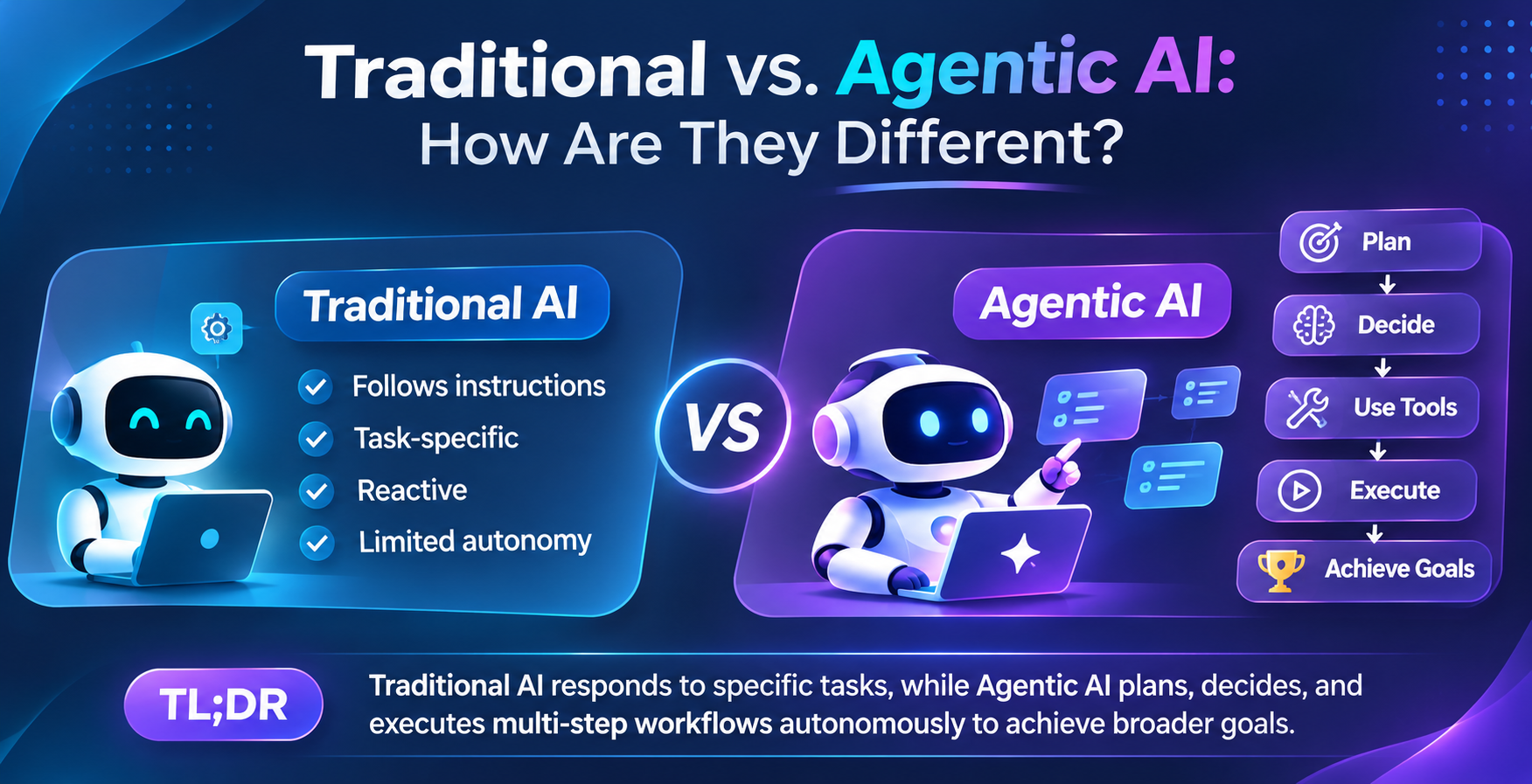
The main difference between traditional and agentic artificial intelligence (AI) is how they work. Traditional AI provides an answer to a question while agentic AI completes a task. This is the primary distinction between the two.
What Do Traditional AI Systems Do?
A traditional AI system is built to do just one thing. An example would be a model that evaluates whether someone can get a loan based upon their application; identifies if there was fraud involved when making a payment; predicts if customers will stop using your product/service (churn); or sorts emails. Once it has provided its output, the system shuts down.
It's up to either a person or another type of software to decide what happens next. Because of its narrow focus, traditional AI systems are very dependable. In addition, testing them is relatively easy and they cost less than other forms of AI. Therefore, they've been around for quite some time now.
What Agentic AI Does?
Agentic AI is provided with an objective as well as a task. Once it has received its objective, Agentic AI will create a plan on how to accomplish that objective. After creating a plan, Agentic AI will utilize tools to complete each step of the plan. Following completion of each action, Agentic AI will assess whether or not the desired outcome was achieved.
If the outcome was not successful, Agentic AI will repeat the previous actions until the goal is met. An example of what Agentic AI could do would be to assist in resolving a customer's billing issue.
In order to resolve the issue, Agentic AI may read an email from the customer, look up the customer's account information, determine if a refund should be issued based upon the company's refund policy, issue a refund to the customer and finally send a message back to the customer confirming that their issue has been resolved.
As you can see, there are many benefits associated with utilizing Agentic AI in businesses today. One major advantage of utilizing Agentic AI in businesses is that these types of agents have the ability to perform tasks that involve multiple systems working together which were previously performed by humans who had to manually operate all of the different systems involved.
Where Do They Different?
Traditional AI is used to create one-time predictions; while agents are designed to make many decisions.
- Decisions: People use traditional AI to determine their next move or to follow pre-defined rules; when using agents, people will base their decision on the parameters you provide.
- Risk: It's easier to identify when an AI has made a poor prediction than it is to identify when an agent has taken a negative action (i.e., sent a refund to someone who didn't deserve it).
- Cost: Because each task that an agent performs could potentially involve calling multiple models, you should monitor the cost from the start.
- Testing: You can test classifiers based on how accurate they are; however, you have to test agents throughout all aspects of a workflow, including what happens if a piece of equipment breaks down.
Which of These Will Help Your Firm?
Traditional AI should be used for tasks that have predictable outcomes based upon structured data. Examples include fraud detection; forecasting of demands; and image verification.
Agents should be used to read unstructured inputs; make decisions using policies; then update other systems. Examples include customer support tickets; invoice processing; and employee onboarding.
Many teams use both. A traditional model scores the risk, and an agent handles the follow-up.
What Enterprise Agentic AI Needs to Work?
What enterprise agentic AI requires to function Enterprise agentic AI will fail for common reasons such as the agent having too much access, no one tracking what the agent did, or no one testing the agent on real examples. There are several habits that can prevent much of this from occurring:
- Only provide the agent with the permissions needed to accomplish the task.
- All decision-making related to money, legal and customer commitments should be sent to a person for approval.
- Log all actions so you can review them at a later time.
- Prior to launching, test on actual examples from your own business processes.
Start with one process where errors are inexpensive; and as long as the logs show that the agent is making appropriate decisions, then allow the agent to make more decisions.
Final Thought
Traditional AI is still relevant; agentic AI is not magical. Each has its own set of uses. Choose which one to use depending on how your work looks. If you're considering using agents in a real-world application. Businesses can Choose in between an expert Agentic AI development company can help develop an agentic system as per their industry needs.


Responses